
How a Cairns Café Chain Used Custom Shirt and T-Shirt Orders to Boost Staff Retention by 34%
Discover how one Australian café group used custom shirts and t-shirts strategically to unify their team, lift morale, and drive measurable business results.

Written by
Wyatt Chen
Custom Apparel
The Barista Uniform That Changed Everything
When Saltwater & Steam, a fictional but entirely believable café group operating across four locations in Cairns, decided to overhaul their staff presentation in early 2023, the managing director didn’t call a branding agency. She sat down with her shift supervisors, asked them what they’d actually want to wear for an eight-hour shift in Queensland’s humidity, and started from there.
The result was a two-tier apparel strategy — custom polo shirts for front-of-house supervisors and branded t-shirts for kitchen and bar staff — that ended up doing far more than making the team look sharp. Within twelve months, staff turnover dropped from 51% to 34%, customer recognition of the brand lifted significantly, and the group’s average Google review score climbed from 4.1 to 4.6 stars across all four venues.
The decision at the centre of all of it? Understanding the genuine difference between a shirt and t-shirt, and using both deliberately rather than defaulting to one.
This article breaks down exactly how they did it, what the research behind their choices looked like, and what any Australian business, school, or organisation can take from their approach.
Why the Shirt Versus T-Shirt Choice Is Never Just About Fabric
Most promotional apparel decisions get made backwards. Someone books a trade show, panics about looking cohesive, and orders 50 of the same thing without asking whether that garment actually serves the situation. The Saltwater & Steam approach flipped that entirely.
Their operations manager spent three weeks before placing any order mapping out two questions: where will each staff member be standing, and what impression should that person give a customer?
Front-of-house supervisors, she determined, needed to project quiet authority — approachable enough to handle complaints and confident enough to manage a queue of tourists at 9am on a Sunday. Kitchen and bar staff needed comfort, breathability, and the ability to move freely through a cramped service environment.
That analysis led directly to the fundamental distinction that any Australian organisation ordering custom apparel needs to understand: the shirt and t-shirt categories serve different social and functional purposes, and each carries its own branding logic.
The T-Shirt as a Workhorse Garment
The custom t-shirt — a short-sleeved, crew-necked garment typically cut from cotton, polyester, or a cotton-polyester blend — is the backbone of promotional apparel across Australia. Its appeal is immediate: it’s affordable, it’s universally comfortable, and it accepts decoration beautifully across nearly every major printing method.
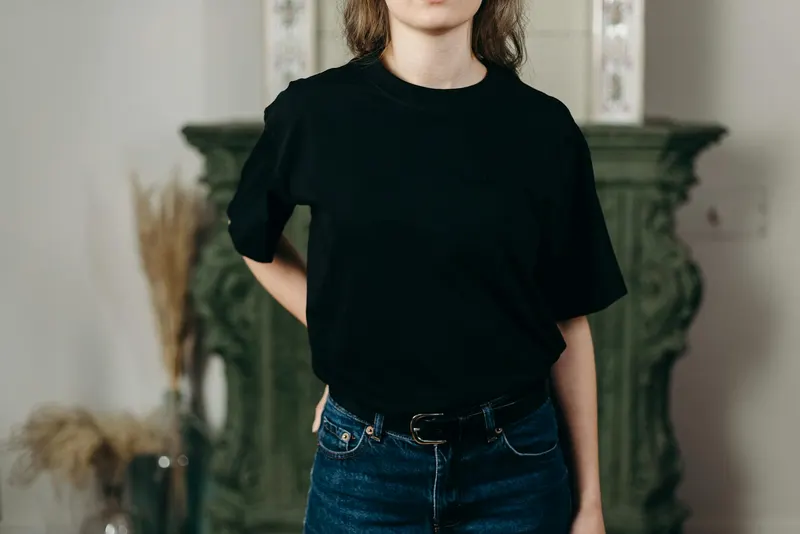
For Saltwater & Steam, their kitchen and bar staff received 180gsm cotton crew-neck tees in a deep espresso brown, screen-printed with the café’s logo centred on the chest. The total cost across 62 units across all four venues came to approximately $11.40 per shirt, including setup fees — a budget-conscious outcome that left room to order replacement stock quarterly.
The practical case for t-shirts in a hospitality or events context is hard to argue with. They breathe well in warm environments, they launder without fuss, and they create visual consistency even when the rest of a staff member’s presentation varies. For a Cairns kitchen in summer, that breathability point alone was worth the decision.
Beyond hospitality, t-shirts remain the default choice for:
- Community events and fundraisers — where cost-per-unit matters and you’re ordering for hundreds of volunteers
- School sports days and excursions — where comfort and washability outrank professional polish
- Trade show giveaways — where recipients are more likely to keep and wear a soft, quality tee than almost any other promotional item
- Charity fun runs and corporate team-building days — where matching apparel creates esprit de corps quickly and affordably
In each of these contexts, the t-shirt’s versatility is its strongest asset. A well-chosen blank in a quality cotton-poly blend, decorated with a clean, correctly sized logo, does more branding work over its lifetime than almost any other promotional product.
The Collared Shirt as a Positioning Tool
When Saltwater & Steam elevated their supervisors into custom polo shirts — a structured, collared garment with a three-button placket and a slightly longer back hem — something interesting happened almost immediately. Customers started directing questions specifically to those staff members.
This wasn’t accidental. It was the collared shirt doing its job.
In the promotional apparel world, “shirt” in a professional context most often refers to a polo shirt, a corporate button-up, or an open-collar dress shirt. These garments carry visual weight that a t-shirt simply doesn’t. The collar alone signals authority and intentionality. It says this person is in a role with responsibility, and the organisation behind them takes that seriously.
For the café group, their supervisors wore a 220gsm cotton-piqué polo in the same espresso brown as the kitchen tees, but with the brand’s full wordmark embroidered at the left chest rather than screen-printed. The embroidery added approximately $4.80 per unit to the cost — bringing each polo to around $29 per unit at an order quantity of 18 pieces — but created a clear visual distinction that served a genuine operational purpose.
The lesson here isn’t that polos are always worth the premium. The lesson is that the premium is justified when the garment is doing a specific communication job.
Collared shirts and polos make particular sense for:
- Corporate uniforms and client-facing roles — real estate agents, financial services staff, account managers
- Trade show booth staff — where you want your representatives to look polished and identifiable
- Healthcare and allied health practices — where trust and professionalism need to be communicated instantly
- Retail floor staff — where customers need to be able to identify team members quickly in a busy environment
- Award ceremonies and corporate presentations — where a plain tee would feel underdressed
The Numbers Behind the Two-Tier Strategy
Let’s put some concrete figures on what Saltwater & Steam’s apparel approach actually cost and returned.
Initial order across four venues:
- 62 custom t-shirts at $11.40 per unit = $706.80
- 18 custom polo shirts at $29 per unit = $522.00
- Total initial outlay: $1,228.80
Replacement cycle: T-shirts replaced quarterly; polos replaced every six months. Annual apparel spend settled at approximately $3,400 — a figure the managing director noted was less than the cost of a single recruitment and onboarding cycle for one casual staff member.
When the group’s staff turnover dropped from 51% to 34%, the operations manager estimated the saving in recruitment advertising, onboarding time, and lost productivity at somewhere between $18,000 and $24,000 over the twelve-month period.
The apparel wasn’t the only variable, of course. Better rosters, a staff recognition programme, and a revised induction process all played roles. But in exit interviews, staff consistently mentioned feeling like they were part of something with a genuine identity. The uniforms — the right shirt and t-shirt for each role — were named repeatedly.
Decoration Methods: Getting the Most from Each Garment Type
One of the most practical insights from the Saltwater & Steam rollout was the decision to use different decoration methods for different garment types — a choice that dramatically improved how each looked in service.
Screen Printing on T-Shirts
Screen printing remains the most cost-effective decoration method for t-shirts ordered in volume. Once the screens are set up, the per-unit cost drops substantially with quantity, making it ideal for orders of 24 units or more. The result is a vibrant, durable print that withstands repeated commercial laundering — critical for a hospitality environment.
For a single-colour or two-colour design, screen printing on a standard 180–200gsm cotton tee will give you sharp, professional results at the lowest cost per unit available. If your branding is clean and bold, this is almost always the right call for bulk t-shirt orders.
Embroidery on Polo and Collared Shirts
Embroidery lifts a collared shirt in a way that printing simply cannot replicate. The tactile quality of stitched thread, the slight relief of the design against the fabric, and the longevity of the decoration method all contribute to a premium result.
For polo shirts and corporate shirts ordered in smaller quantities — typical for management-level roles or frontline supervisors — embroidery’s higher per-unit cost is offset by how well the finished garment holds up over time. An embroidered polo in a quality piqué fabric, washed correctly, can comfortably last two to three years in a professional environment.
If your logo includes fine detail or gradient colours, direct-to-garment (DTG) printing or heat transfer may be worth exploring for t-shirts, though both have their own trade-offs in durability and cost.
Choosing the Right Fabric for Australian Conditions
Any Australian business ordering custom apparel needs to account for climate in a way that European or North American guides simply don’t address. Cairns is different from Melbourne. Perth summers are different from Sydney winters. Your fabric choice needs to reflect where your staff will actually be wearing these garments.
For warm and humid climates — Queensland, the Northern Territory, the northern coast of Western Australia — lighter fabric weights in breathable cotton or moisture-wicking polyester blends are non-negotiable. A staff member in a 200gsm cotton tee in Darwin will be more comfortable than one in a 260gsm option, and a comfortable employee performs better and stays longer.
For cooler southern climates — Melbourne, Hobart, the Adelaide Hills in winter — slightly heavier cotton weights or cotton-spandex blends offer more comfort through the working day without requiring additional layers.
For corporate shirts and polos worn in air-conditioned office environments, cotton-piqué remains the gold standard for its structure, breathability, and professional appearance regardless of geography.
A Practical Ordering Checklist for Australian Businesses
Before placing your next custom shirt or t-shirt order, work through these questions:
Define the use case clearly
- Is this garment for an event or ongoing uniform use?
- Who will wear it, and what does their role communicate to customers?
- Will it be laundered commercially or at home?
Choose your garment type based on function
- Crew-neck t-shirts for active, casual, and event-based roles
- Polo or collared shirts for client-facing, supervisory, or professional contexts
Select your fabric weight based on climate
- 160–180gsm for warm, humid Australian climates
- 190–220gsm for temperate or air-conditioned environments
- 220gsm+ for cooler southern regions
Choose your decoration method based on design and quantity
- Screen printing for bold, simple designs in volumes of 24+
- Embroidery for polo shirts and professional garments in smaller runs
- DTG printing for photographic or multi-colour designs on t-shirts
Confirm sizing and fit inclusivity
- Australian workforces are diverse — ensure your size run includes options from XS through to 5XL where needed
- Request samples before committing to a full bulk order
What Other Australian Organisations Can Replicate
The Saltwater & Steam story isn’t a hospitality success story — it’s a decision-making framework story. The café group succeeded not because they spent more, but because they thought more carefully about what each garment needed to accomplish.
A Geelong sporting club ordering shirts for its committee members and t-shirts for its volunteers is making the same core decision. A Brisbane accounting firm outfitting its graduate intake in polos for client days and tees for internal training days is doing exactly the same thing.
The shirt and t-shirt distinction, properly understood, is a communication strategy in fabric form. Get it right, and your branded apparel does active work for your organisation — building identity, signalling professionalism, and, as one Cairns café group found out, keeping your best people around a little longer.